<VECTOR 1>
glitch(alike) prompts
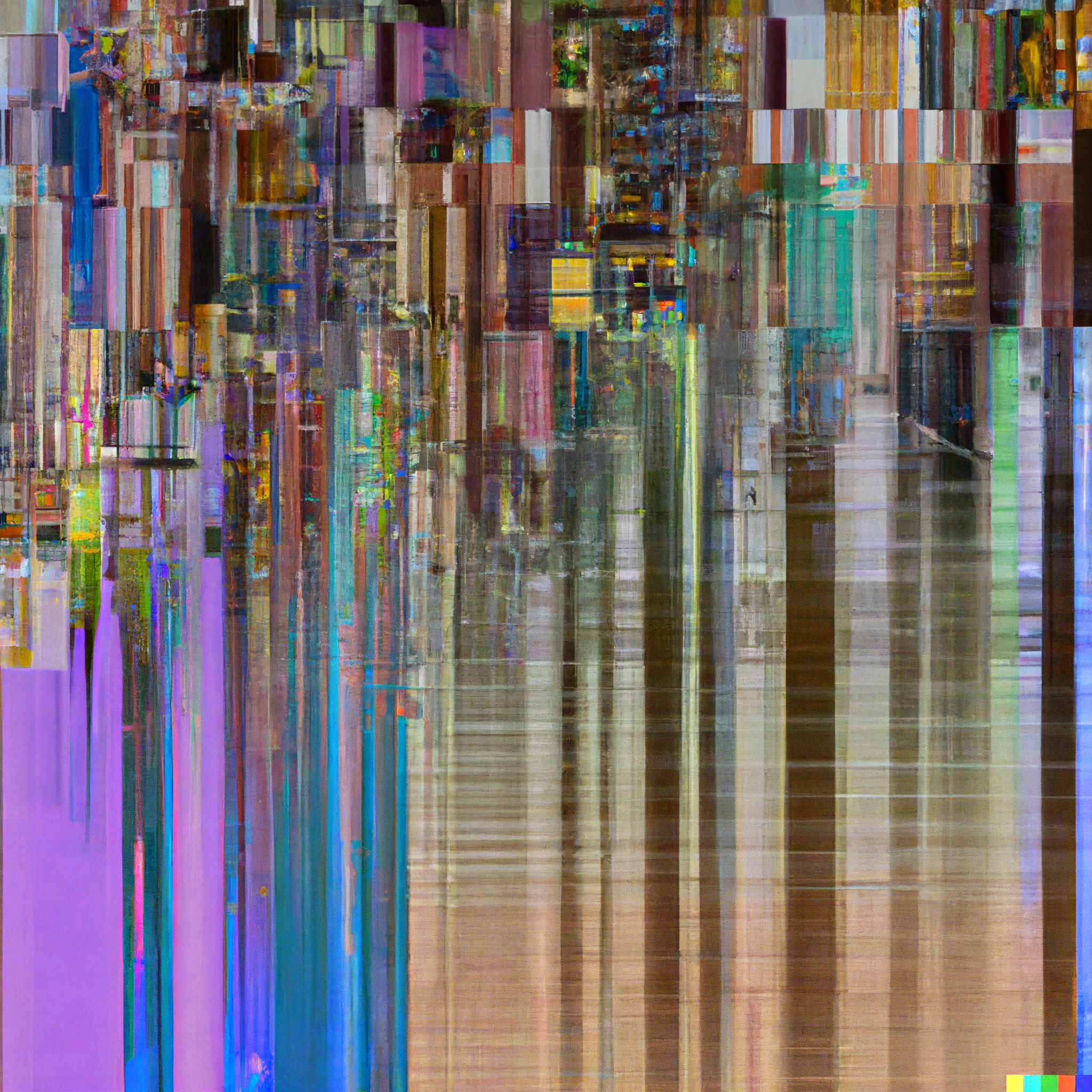 <vector-view-1>: glitch(alike) prompts: Image generated by the author by giving Dall-E 2 the prompt “glitch art,” and upscaled using a Latent Diffusion Super Resolution (LDSR) model
In its "purest" form, glitch art is created by intentionally provoking system failures, && so it might help to first get oriented w/the systems we're aiming to disrupt. The central components in most popular modern AI systems are artificial neural networks. From the outside these are black boxes, seemingly simple functions which take some arbitrary data as input && return some arbitrary data as output. On the inside, these are multi dimensional grids /billions of parameters (numbers also known as "weights" and "biases") connected together across multiple layers. A raw neural network, is like a massive interwoven set of domino rallies, each domino a "neuron" w/it's weights and bias printed on them. In a domino rally the numbers printed on the domino are static + meaningless, but the parameters of a neuron are everything, they effect which neurons knock over (or "activate") the neurons in the next layer. At first, these parameters are randomized, but by training a neural network on troves of data, the weights + biases are adjusted resulting in a trained "model" which can work wonders.
Today we've trained models which can drive cars, predict the future && create art; the most popular type of neural network for generating images are called diffusion models. Trained on large data sets of images accompanied by natural language descriptions, these models can synthesize brand new images from any arbitrary text input. The image in <vector-view-1> was one of many i generated by submitting the text prompt "glitch art" to OpenAI’s DALL-E. i imagine many glitch artists would not consider this image a glitch in the purest sense, but rather a glitch-esque image or "glitch-alike”2: an image w/glitch aesthetics created by some other means. This image was not produced by corrupting the data, short circuiting the neural network or otherwise misusing an AI model, there is no misuse or malfunction occurring here, the model is operating exactly as intended.
Apps designed to produce glitch-alike images have been around for over a decade, but most of these produce images which wouldn't fool a trained glitch artist's 👁️. These new AI models, however, create fairly convincing glitch-alikes. This particular glitch-alike <vector-view-1> reminds me of the glitches i'd get when corrupting video compression algorithms3, but when i looked closer i noticed peculiar artifacts4, not those associated with image/video compression, but rather artifacts unique to this AI image diffusion process. The macro blocks that appear when databending a JPEG should be uniform in size but these were not. The grid of pixels that become more apparent when glitching images should be perfectly aligned, but these were structured slightly diff'ly. In many of these "glitch art" prompted images the pixels almost looked as though they were painted by hand, the way Gerhard Richter would reproduce the artifacts of photography in his paintings5. This is likely a reflection of the model's bias, i'd guess its training data contains less JPG glitches than it does hand drawn paintings.
<vector-view-1> is the model's attempt at imagining (or "inferencing" in AI lingo) a traditional piece of "glitch art" as prompted. On the surface this is a "glitch-alike", but upon close inspection the model's bias is subtly exposed. If a glitch is a moment in a system that catches us off guard, && by doing so reveals aspects of that system that we might overlook, then perhaps this particular glitch-alike is a glitch after all?